Inquiry
Form loading...
Outdoor Construction Adhesive is not a one-product solution for every exterior repair. The right choice depends on the materials, joint size, exposure, and movement the bond must handle. A bead joining concrete steps differs from one securing trim to treated lumber. Rain, freeze-thaw cycles, direct sunlight, and standing water can also affect performance. Read the product label and technical data sheet, not just the front of the tube.
This 2026 guide explains how to compare adhesive types, check substrate compatibility, and interpret cure time, temperature range, and water-resistance claims. It also covers surface preparation, application, and practical safety steps, because even a strong formula can fail on dusty concrete or damp wood. Small details matter. A cold cartridge may flow poorly; a narrow bead may leave gaps. A small test on a hidden area can reveal problems before the visible finish is at stake. Confirm that the product is intended for exterior use and suits the exact materials involved. When a project carries weight or failure could have serious consequences, follow manufacturer instructions and seek qualified advice rather than guessing. I have learned that “all-weather” on a label can sound more reassuring than it is. Use this guide as a careful starting point, then verify the product against your site conditions before buying.
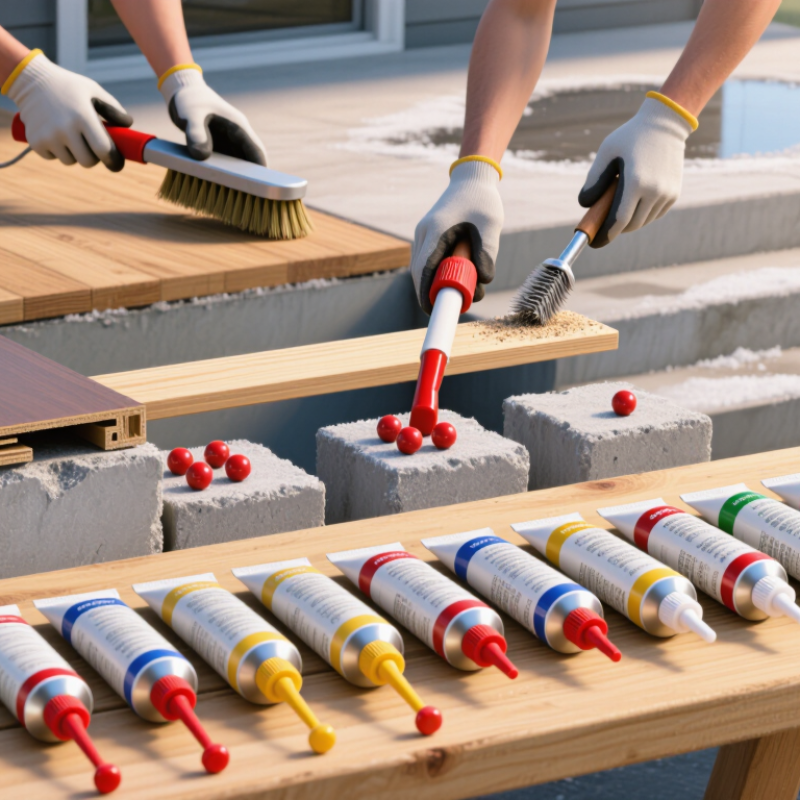
How to Choose Outdoor Construction Adhesive in 2026?
Start with the actual bond: plywood to lumber is different from metal to concrete. Note each substrate, surface condition, and exposure, including rain, temperature swings, and standing moisture. ASTM D3498 covers field-applied adhesives for bonding plywood to lumber framing in floor systems. It does not automatically qualify an adhesive for every outdoor joint or exposure. Check the current standard’s scope and the adhesive’s documented performance conditions. A familiar label is not proof of suitability.
Moisture deserves close attention. The USDA Forest Products Laboratory’s Wood Handbook places wood’s fiber saturation point at roughly 25–30% moisture content, with variation by species. Wood can swell and shrink as moisture changes, stressing a rigid bond. APA’s Engineered Wood Construction Guide recommends a 1/8-inch gap between many panel edges and ends to accommodate expansion. Small gaps matter. Before bonding, remove dust, confirm surfaces are dry enough for the adhesive instructions, and check that the lumber is sound. I would still verify the exact panel type and exposure requirements; that step is easy to rush. Cite ASTM D3498, the USDA Forest Products Laboratory Wood Handbook (FPL-GTR-282), and APA’s Engineered Wood Construction Guide when documenting the selection.
| Selection dimension | What to identify | Practical selection guidance | What to verify |
|---|---|---|---|
| Substrate pair | Name both materials and their surface condition: for example, plywood to lumber, wood to concrete, or metal to masonry. | Choose an adhesive whose technical data sheet explicitly lists both substrates. Porous and nonporous surfaces can require different products or preparation. | Substrate compatibility, required surface preparation, and whether a primer is needed. |
| Weather exposure | Determine whether the bond will be sheltered, exposed to rain, subject to standing water, or repeatedly wetted and dried. | Use an adhesive specifically rated for the expected service exposure. “Water resistant” does not necessarily mean suitable for continuous immersion or an exposed structural joint. | Exterior-use statements, water-exposure limits, and any restrictions on prolonged wetting. |
| Sun and temperature | Check direct sunlight, expected service-temperature range, freeze-thaw cycles, and temperature during application. | Adhesive performance and cure can vary with temperature. Protect exposed adhesive from UV where the product instructions require it; the joint may need a covering or sealant. | Application-temperature range, service-temperature limits, cure time, and UV-exposure guidance. |
| Joint movement and fit | Assess gaps, material movement, vibration, and whether the joint is intended to carry structural loads. | Use only within the product’s stated gap-filling and load-use limits. Construction adhesive does not replace mechanical fasteners or a designed connection where those are required. | Permitted gap size, bond-line thickness, clamping or fastening instructions, and structural-use limitations. |
| Wood moisture and condition | Check for dampness, dirt, coatings, preservatives, oil, and loose or damaged wood fibers. | Follow the adhesive maker’s moisture and preparation limits. Some products bond poorly to wet, contaminated, sealed, or treated surfaces unless expressly approved. | Maximum substrate moisture, cleaning or abrasion steps, and compatibility with treated lumber or coated panels. |
| ASTM D3498 relevance | ASTM D3498 addresses adhesives for field-gluing plywood to lumber framing for floor systems. | Consider it when the project involves that specific plywood-to-lumber floor-system bond. It is not a general specification for every outdoor construction adhesive or every substrate combination. | Check the current standard edition, its scope, project documents, and whether the adhesive documentation states compliance for the intended application. |
| Application and cure | Review working time, open time, cure conditions, bead size, and whether the assembly can be held in position. | Plan installation around the product’s instructions and weather conditions. Do not assume full strength immediately after application. | Application method, required contact or pressure, cure schedule, and rain exposure before cure. |
| Final suitability check | Confirm the intended use, building requirements, exposure, and consequences of bond failure. | For load-bearing or code-regulated work, use the specified system and obtain qualified design or inspection advice where required. | Technical data sheet, safety data sheet, applicable project specifications, and local code requirements. |
Selection note: Match the adhesive to both bonded materials and the actual exposure conditions. ASTM D3498 is specific to field-glued plywood-to-lumber floor-system applications; it should not be treated as a universal outdoor-use rating.